When a new boy enters her third grade class, Nora’s staid life as a quiet, dependable elementary school teacher simmers to scintillating as she falls headlong into an intense friendship with the boy’s mother, Sirena, an artist and the boy’s father, Skandar an intellectual, as well as with the boy himself. Nora’s long suppressed desires to lead her own creative life are tested against the example of Sirena with whom she comes to share a studio. In Claire Messud’s mesmerizing new novel, The Woman Upstairs, she portrays the inner world of Nora with such psychological precision and subtlety, we find we’re falling headlong too, before we even notice. Is it a cautionary tale? A wake-up call for women still struggling to name themselves artists before all others? Read it, and tell us what you think….
Archive Page 6
Who is that woman upstairs?
Published November 15, 2013 Books we love , Fiction , Novelists Leave a CommentTags: Claire Messud, contemporary literature, psychological novels, Woman Upstairs
A Stone for Nina
Published June 10, 2013 Books we love , Memoir , Uncategorized , Writing Leave a CommentTags: character development, memory, Paul Genega, Stone For Nina, writing workshops
One of the truly remarkable experiences we’ve had here recently was a reading by Paul Genega of his short prose piece, A Stone For Nina. An elegy really, the story describes a fascinating and unusual older woman who befriends a group of naive but intelligent college boys. It’s the late ’60s Washington, D.C. Nina has a long tale to tell about her life, full of strange twists and turns and possible fabrications. She captures the heart and imagination of our narrator, a sensitive and perceptive soul. Author and poet Paul Genega’s reading of this piece joined voice, cadence, word, and physical gesture all in subtle and expressive alignment. It was as if all the many disparate elements of a life harmonized in the work of this artist, writer Paul Genega.
In fact, Stone for Nina is such an impressive work, I’ve decided to devote an entire writing workshop to the piece. We will read and closely examine the piece, and use it as inspiration for our own long loving look at character, memory and storytelling. Contact the shop for details about this summer workshop, “Character, Memory and the Long Short Story”.
We were delighted that Paul’s proud father, in his nineties, was able to attend the event and share in the accomplishment of his son.
Editor, publisher and poet Antje Katcher also read from her new poetry collection, For Bananafish, a collection of recent work, sestinas and haikus that demonstrate strict adherence to form combined with surprising flights of imagination. Both works are published by Three Mile Harbor Press. Signed copies are available at Canio’s.
Steinbeck Slept Here!
Published February 28, 2013 Bookstore Lore , Literary history , Sag Harbor , Uncategorized Leave a CommentTags: Garrison Keillor, John Steinbeck, literary birthdays, Sag Harbor literary history, Writer's Almanac
Today, February 27, is John Steinbeck’s birthday as noted, thoughtfully, but incompletely by Garrison Keillor on The Writer’s Almanac. (http://app.info.americanpublicmediagroup.org/e/es?s=1715082578&e=9333&elq=daf1cddcd35f43fa88e5fe39e05aa6ae)
We must add that Steinbeck lived, worked, fished, drank and generally had a good time here in Sag Harbor on the East End of Long Island. Some have called ours a “charming fishing village” not dissimilar to Steinbeck’s beloved Monterey Bay. Steinbeck spent the last decade of his life here, driving out from New York when his works were performed on Broadway stages.
We see a steady stream of Steinbeck fans on pilgrimage who stop in to ask about where he lived — The writer’s home is now a private residence overlooking Sag Harbor Cove. Our literary walking tours always wind up there, a respectful distance from the place he wrote The Winter of Our Discontent. It’s said he based several characters on Sag Harbor locals. Steinbeck’s American road book, Travels with Charley begins here in the wind-churned cove, just as Hurricane Donna blows through:”Under the big oak trees of my place at Sag Harbor sat Rocinante…”
John found pals among the locals, fishing buddies and drinking buddies in the days of the notorious Black Buoy bar when Sag Harbor was a place God-fearing mothers forbade their kids from venturing to. But local folks just let Steinbeck be Steinbeck, allowed him his privacy. In a show of affection for what was then a proudly blue-collar town, Steinbeck helped create our Whalers festival, a giant street parade and rowdy weekend party featuring boat races that once brought sailors and boozers from far and near. The festival, now toned down as Sag Harbor has gone upscale, is celebrated as HarborFest, in early September when the crowds have dissipated, but when the weather’s still fine.
Steinbeck conducted his war with the ospreys here, as described in a humorous piece we included in our Sag Harbor Is: A Literary Celebration. At the centenary of his birth, we hosted a Steinbeck celebration with an exhibit of photographs from the family collection and a stirring tribute by Steinbeck’s friend, the late Budd Schulberg. There’s a beautiful bronze bust of the writer in our beloved John Jermain Library, a tribute to the village’s claim on the Nobel Prize winner.
All this to say, Steinbeck once slept here! He lived here, played here, wrote here. Happy Birthday, John Steinbeck. Sag Harbor salutes you!
Keep It Simple
Published January 15, 2013 Community , Current Events , Environment , Uncategorized Leave a CommentTags: clutter, community discussion courses, Duane Elgin, environmental well being, New Year's resolutions, Northwest Earth Institute, sustainability, Voluntary Simplicity
Stacks of books and boxes, piles of paper, catalogs, bills surround us. Call it clutter, or call it cozy lived-in. We’ve got lots of “stuff” here at the bookshop, most of it important, but some of it could go. So we’re eager to start another community discussion course this month called Voluntary Simplicity. We’ll address not just physical clutter, but personal as well as environmental clutter.
Call it ironic that here in the fabulous Hamptons a sandbar of conspicuous consumption, a small group of folks will gather to discuss how to get more out of life with less.
In 1981 Duane Elgin’s book, Voluntary Simplicity: Toward a Way of Life That is Outwardly Simple, Inwardly Rich announced the movement. Reissued in 2010, Voluntary Simplicity has become even more relevant, mainstream rather than marginal, more urgent. According to Elgin, voluntary simplicity helps create community through a common purpose; protects plants and animals from extinction; promotes self-discovery and well-being among humans, all the while promoting a balanced use of Earth’s precious resources. In fact, voluntary simplicity is crucial to a sustainable future.
Voluntary Simplicity, a five-week course designed by the Northwest Earth Institute, begins at Canio’s Tuesday, January 29. We’ll read intriguing articles, discuss our experiences, as we become more aware of how we’re spending our precious time, our limited resources. We’ll discover how these choices affect our health, our relationships, and Earth.
Pre-registration is required along with a $30. materials fee. Space is limited; contact us soon! The program is sponsored by Canio’s Cultural Cafe.
We Made the List!
Published January 12, 2013 Bookselling in the 21st century , Community , cooking and food Leave a CommentTags: David Slater, East End celebrities, Hamptons Magazine, namedropping, The List
A chance meeting with our friend, the artist David Slater led to the discovery. “Hey,” David said across Espresso Market where I stopped for some minestrone. “Did you see your name in the paper?” he asked excitedly. Well, no, I hadn’t. “What did I do?” I asked. He pulled out the December issue of the big glossy Hamptons Magazine, and there on page 38 was indeed my name, Maryann Calendrille, 16th under Steven Spielberg who heads the list. Hmm, good company so far. David Slater’s name appears at the tail of that first column. Three names later we find photographer Kathryn Szoka, right after Martha Stewart and Nelson DeMille. How our names were chosen for this list, and what it all means, remain a mystery.
“It’s the list of cool people,” David explained. “Great,” I replied. “I’ve finally made it.” Just then my soup was ready. “Let’s have a party,” I suggested. “A list party,” David rejoined. We’ll be inviting some of the others on that list: Robert De Niro, Jennifer Lopez, and Katie Couric to name a few. We’ll want to include other East Enders: Sag Harbor art gallery owners Laura Grenning and Richard Demato, poet Marvin Bell, sculptor Diane Mayo, playwright Jon Robin Baitz, poet/painter Sarah Plimpton, and artist Elisca Jeansonne. Documentary filmmaker Jacqui Lofaro, painter Frank Wimberley and artist Michael Rauch will also be getting an invite. Since Ina Garten is also listed, not that we’re name-dropping or anything, we’ll just have to try of few of her new recipes from Barefoot Contessa’s How Easy Is That? Sounds like a cool party!
Remembering Harvey Shapiro
Published January 10, 2013 Poetry , Uncategorized 1 CommentTags: Harvey Shapiro, World War II poetry
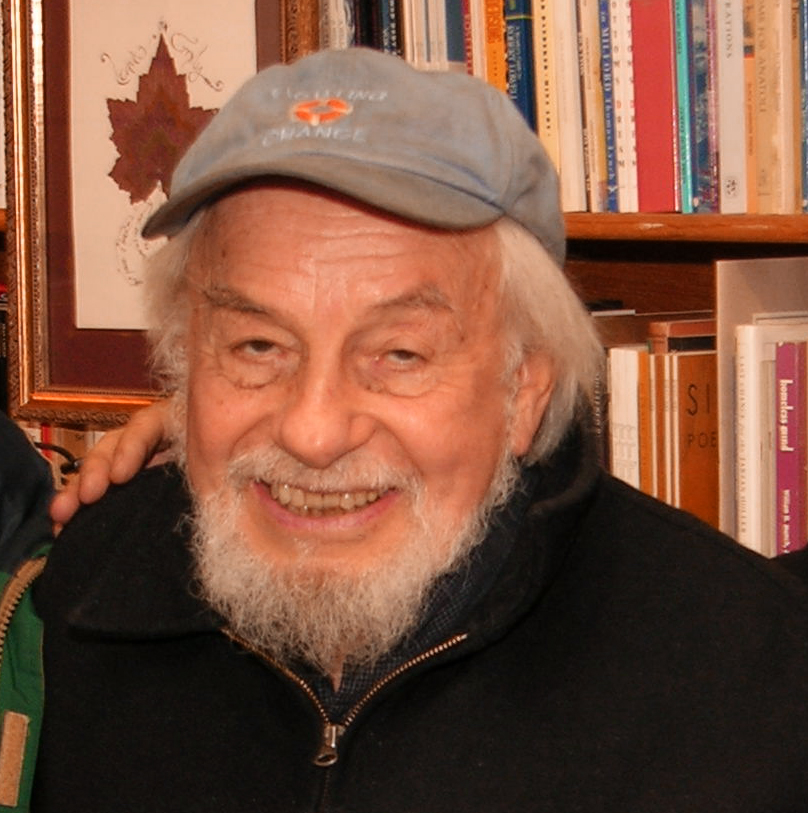
Word reached us that poet Harvey Shapiro died on January 7, 2013. Harvey, a longtime and loyal customer of the bookshop, read at Canio’s several times from his various collections including How Charlie Shavers Died and Other Poems; The Sights Along the Harbor, and the volume he edited: Poets of World War II published by The Library of America. Here’s one from The Sights Along the Harbor.
To Nature
Sun gilding each lance-like pine needle.
One needs to have a proper attitude of respect
as a Jew only recently out of his village in Russia
would have had when he first ventured
from the Lower East Side on to broad Fifth Avenue.
My eyes are wide. I lift my cap.
We lift our cap to Harvey, who always had a ready smile and affable way about him, who supported other poets, and who seemed to remain just a regular guy even though his many prestigious accomplishments lift him above the crowd.
Winter Jazz Warms the Bookshop
Published January 6, 2013 Community , Music at Canio's , Uncategorized Leave a CommentTags: Bryan Campbell, jazz performance, jazz quintet, Steve Shaughnessy, Tom DePetris
Some Monk tunes, “Olio”, “Here’s That Rainy Day” and a beautiful traditional hymn often performed by John Fahey… just some of the numbers performed by jazz bassist Steve Shaughnessy and guitarist Bryan Campbell at Canio’s recently. A beautiful way to close out 2012 despite the stormy weather that night. Snug inside the bookshop and before an intimate appreciative audience, these two fine musicians seemed to pull notes out of the air each complementing the other in a respectful collaboration. Shaughnessy and Campbell often play at the Bay Burger Jazz Jam, and we’re happy to note, will be performing weekly in a quintet at World Pie in Bridgehampton beginning Thursday, January 10 from 8 to 11 p.m.
Campbell is currently pursuing a Master’s degree in Jazz Performance at Queen’s College. He is a gifted artist with a long career ahead of him. Shaughnessy, a master musician in both classical and jazz performance, a long time member of the South Fork Chamber Orchestra, is also a music educator. He and jazz guitarist Tom DePetris have collaborated for decades particularly when DePetris headed up the jazz fusion band Solar popular on the East End. DePetris was scheduled to appear at Canio’s as he has many times before, but bad weather changed that. We hope to welcome Tom back another time.
On this late December night, the lovely notes of “I Fall In Love Too Easily” swirled among the poetry and art books, and seemed to say it all!
Mark Doty on Best American Poetry
Published December 29, 2012 Books we love , Poetry , Reading events Leave a CommentTags: Best American Poetry, Mark Doty, poetry readings
No one could possibly read all the poetry published in America in one year. You couldn’t find it all! Mark Doty said recently at Canio’s. But through a very efficient and fair process established by series editor David Lehman, Doty, this year’s guest editor of Best American Poetry 2012 read thousands of poems and selected 75, every one of which, he claimed, he loved.
He strove to create an anthology that includes poems from different regions around the country, from both large and smaller literary publications, diverse in gender, ethnicity, and poetic styles.An exciting, engaging and sometimes challenging collection has emerged from this patient, attentive editorial effort. Mark presented a few of his faves to an appreciative audience. We heard wonderful poems by Alicia Ostriker, Honor Moore, Kerrin McCadden, Richard Howard, Carol Muske- Dukes and Lucia Perillo among others.
Poetry is a report on the senses, what we see and hear, what we think, and it arrives at some emotion, Doty explained. He hopes to be swept up, compelled by a poem. And while reading vast numbers of poems, he endeavored to keep an open mind, to ask of the poem, “where does this take me?”
The best poetry takes us to unexpected places, places at once strange, yet somehow recognizable.
Rilke Through the Storm
Published December 29, 2012 Books we love , Poetry , Uncategorized Leave a CommentTags: hope, Mark Burrows, poetry and prayer, Prayers of a Young Poet, Rilke, translation
A string of very dark nights, post-Superstorm Sandy were lighted by a new collection of Rilke poems, Prayers of a Young Poet translated by Mark S. Burrows and just out from Paraclete Press. These are supple renderings of poems some of which we’ve never seen before in English. Without electricity for a week, I lit the hurricane lamp and read “I love the dark hours of my being,/ for they deepen my senses…”and followed the voice of the monk traipsing through the dark forest of his soul.
A bit more than a month later, we were inundated with another wave of bleaker darkness as the tragedy at Sandy Hook Elementary School left unspeakable grief in its wake. Poetry is not a cure nor can it protect us from evil, but in it we hear the human voice of anguish: “You are the forest of contradictions./ I could rock You like a child,/ and yet Your curses reach their goal/ and wreak havoc among the people.”
It’s really too much to burden these poem-prayers with our contemporary events but through them we plumb the depths to arrive at constants. We hear the strivings of one seeking wholeness: “This is my daily work over which/ my shadow lies like a shell./ And even if I’m like leaves and loam,/ whenever I pray or paint/ it becomes Sunday once again, and in the valley/ I’m the voice of a praising Jerusalem.” These earnest “prayers” of the young poet Rilke, cry out not from the mountaintop, but from deep within that dark valley, a troubling night when searching is all.
In his Afterword, Mark Burrows comments on his translations: ” My hope is that these renditions enable Rilke’s poems to gesture beyond what they say, thereby conveying a sense that is as free and dynamic in English as in the original German. When they do this, they call us to ‘widen [our] solitudes/ from one new beginning to the next’ , glimpsing with the poet what he calls ‘the radiance of a new page/ on which everything could still come to be.’
This New Year, this 2013, let it be so.
 The Canio's Books Blog